The Fundamental Longing for Truth
Have you ever stopped mid-stride in your busy life, looked around, and felt a quiet, nagging suspicion that something fundamental was missing? That feeling—that subtle awareness that we are living a life based on fleeting perceptions rather than enduring truth—is the very reason this mantra exists. It’s one of the most famous and universally adored verses in Hindu philosophy, but it isn’t a chant for any one deity. It is a pure, unadulterated prayer to the Divine Principle itself, this shanti mantra found in the ancient Brihadaranyaka Upanishad.
It’s often called the Pavamāna Mantra, meaning the ‘purifying mantra,’ and it represents the spiritual seeker’s most earnest request. The mantra is an invocation, a deep internal commitment, and a complete roadmap for transformation, all wrapped into three simple, potent lines:
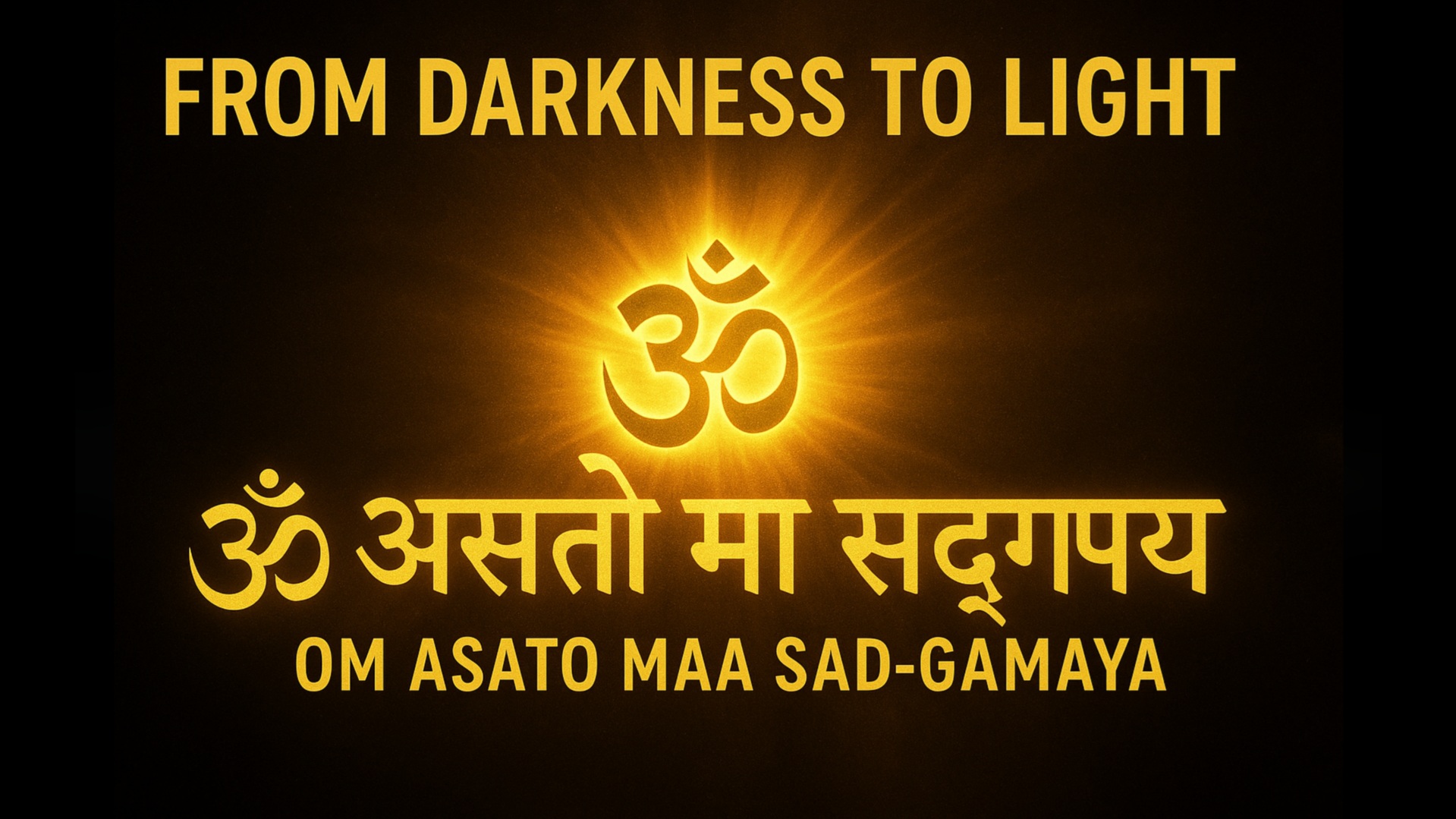
ॐ असतो मा सद्गमय ।
तमसो मा ज्योतिर्गमय ।
मृत्योर्माऽमृतं गमय ॥
ॐ शान्तिः शान्तिः शान्तिः ॥
Not towards darkness, lead us to light
Not towards death, lead us to immortality
Om peace, peace, peace!
Let’s unpack what these lines truly mean for our lives here, today.
1. Asato Mā Sad-Gamaya: From Illusion to Reality
The first line is the foundation of all spiritual seeking: “Lead me from the unreal to the Real.”
In our modern world, the “unreal” (asat) isn’t necessarily something mystical or supernatural; it is the constant, day-to-day illusion of the ego. It’s the belief that our happiness depends on our job title, our bank account, or what someone else thinks of us. It’s the endless mental narrative that says, “I will be happy when…”
The asat is that fleeting, changing reality built on external conditions. The sat is the immutable Truth—the consciousness within you that remains constant, regardless of whether you are successful or failing, healthy or sick.
When I chant this line, I’m not asking for a miraculous escape from my problems; I’m praying for the discernment to tell the difference between my temporary thoughts (the unreal) and my eternal self (the Real). It’s a call to shift our focus from the drama of the story to the unwavering awareness witnessing the story.
2. Tamaso Mā Jyotir-Gamaya: From Darkness to Light
The second line is the psychological and intellectual transformation: “Lead me from darkness to Light.”
The tamas (darkness) isn’t just lack of physical light; it represents ignorance—the ultimate spiritual shadow. Ignorance is our blind spot. It’s the habit we can’t break, the negativity we keep returning to, the lack of clarity that makes us repeat the same self-destructive patterns over and over again.
We often feel lost, paralyzed by inaction, or overwhelmed by confusion. That paralysis is the darkness.
Jyoti (Light) is knowledge or wisdom. It is the clarity that cuts through the fog of confusion. Chanting Tamaso Mā Jyotir-gamaya is a direct invocation of that intellectual and spiritual clarity. It says: “Illuminate my mind, dissolve the ignorance that keeps me trapped in smallness, and show me the path forward.” It’s an appeal to the deep, inner intelligence that already knows the answer but is currently obscured by our own mental chatter.
3. Mṛtyor Mā Amṛtaṁ gamaya: From Death to Immortality
The third line is the ultimate goal, the transcendence of our deepest fear: “Lead me from death to Immortality.”
Every single thing we fear—loss of job, loss of status, loss of a loved one—is a micro-version of the fear of Mṛtyu (death). We cling fiercely to the physical body and the temporary world because we believe that is all there is.
Amṛtaṁ (Immortality) does not promise that our physical body will live forever. That would be another form of the unreal. Instead, it guides us to the realization that our essential nature, the Ātman (Soul/Self), is already eternal. It was never born, and it cannot die.
This line is the powerful recognition that we are not the perishable body or the changing mind, but the timeless awareness inhabiting them. When you realize the Sat (Truth) and gain the Jyoti (Light), the fear of death, which is merely the fear of change, naturally falls away. We realize we are already Amṛtaṁ.
The Echo of Peace: Oṁ Śānti
The mantra often concludes with Oṁ Śāntiḥ Śāntiḥ Śāntiḥ, seeking peace on three levels:
- Ādhyātmika: Peace within the body and mind (internal).
- Ādhidaivika: Peace from divine or cosmic forces (natural disasters, planetary influences).
- Ādhibhautika: Peace from the surrounding world (people, animals, external events).
By asking for peace on all three levels, we make a complete request for harmony in both our inner and outer lives. This mantra is, quite simply, the most elegant and profound self-help program ever conceived. It is the human heart’s eternal whisper for liberation.
Do you have any specific spiritual concepts you’d like me to explore further, or would you like guidance on incorporating this mantra into a daily practice?