The Anchor in the Changing World
In our lives, so much is constantly shifting—our fortunes, our relationships, and even our own minds. This inherent instability is what often drives us to seek something eternal, something that never fails or never falls from its position. In the Sanskrit tradition, this eternal, unwavering quality is embodied by the name Achyuta (अच्युत).
The Achyutāṣṭakam, a sublime eight-verse hymn (or Aṣṭakam), is a heartfelt ode dedicated precisely to this infallible nature of the Supreme Lord (Vishnu/Krishna). Composed by the great unifying philosopher Adi Shankaracharya, the hymn is a testament to the profound truth that devotion (Bhakti) is the most beautiful and direct pathway to realizing the unchanging nature of God.
Shankaracharya, though a proponent of Advaita (Non-dualism), gifted us this Bhakti hymn to establish the necessity of a pure heart. The Achyutāṣṭakam serves as a sādhanā (spiritual practice) that purifies the devotee’s emotions, making the mind steady enough to receive the highest truth.
The Power of Syncretism: Invoking the Lord’s Many Forms
The structure of the Achyutāṣṭakam is remarkable because it performs a beautiful spiritual syncretism, weaving together the most powerful names and forms of Vishnu in a single, flowing prayer:
- The Concentration of Names: The very first verse strings together a garland of names—Achyutaṁ Keśavaṁ Rāmanārāyaṇaṁ, Kṛṣṇadāmodaraṁ Vāsudevaṁ Harim—effectively performing the benefit of chanting multiple major mantras in one verse.
- The Fusion of Avatāras: The hymn does not differentiate, praising Krishna’s acts (slaying Kamsa and Cāṇūra) alongside Rama’s deeds (purifying the Dandakāraṇya forest and being the Lord of Jānakī/Sītā). This unifies the devotee’s spiritual focus, affirming that all divine forms are aspects of the one Achyuta.
- The Abode of Grace: The verses paint a vivid picture of the Lord, describing him as the Indirā Mandiram (the temple where the Goddess Lakshmi/Indirā resides) and the one who is Rādhikā-ārādhitam (worshipped by Rādhikā). This emphasizes that the Lord is the eternal source of both auspiciousness (Śrī) and pure devotion (Bhakti).
Why You Should Chant Achyuta
The spiritual and psychological benefits derived from reciting the Achyutāṣṭakam are powerful and direct:
1. Stability (Achyutatvam): When life feels uncertain, chanting Achyuta centers the mind, reminding the devotee that they are connected to a principle that cannot waver. It builds deep inner stability and resilience against external turmoil.
2. Destruction of Sins (Pāpa Vināśanam): The Phala Śruti promises that the sins accumulated over millions of births (koṭi janma kṛtaṁ pāpaṁ) are destroyed simply by remembering the Lord through this hymn. It is a powerful antidote to negative karma and regret.
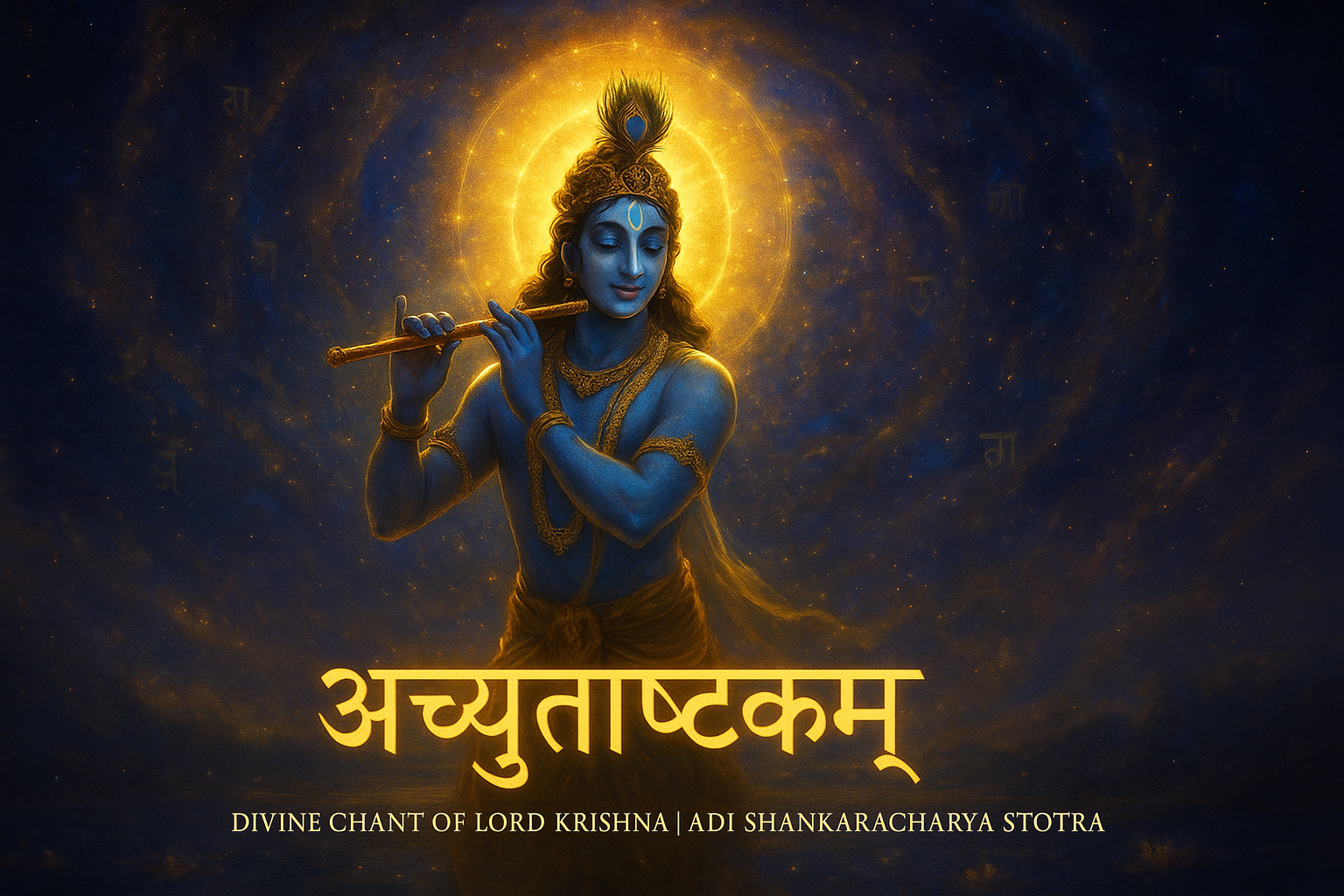
3. Inner Serenity and Calm: By focusing on the beautiful, gentle form of Krishna—with his curly locks (kuṭilālaka) and full-moon face (pūrṇacandra nibhānanam)—the mind is drawn away from anxiety and placed in a state of profound peace and contemplative joy.
4. Divine Vashyam (Captivation): The final verses give an astounding promise: whoever recites this Aṣṭakam with devotion and deep longing (sasprham) for the Supreme Being will quickly find Śrī Hari (Vishnu) captivated by their devotion and drawn to them. It is a formula for attracting the highest form of divine grace and love.
To bring the Achyutāṣṭakam into your daily ritual is to begin every day by consciously aligning yourself with the Infallible, the Eternal, and the most Beautiful Guru of the Universe. It is the practice of securing your spiritual anchor in the timeless reality of God.
Śrī Achyutāṣṭakam (अच्युताष्टकम्) (Achyutashtakam) Sankrit Mantram, Transliteration and Meaning
The central theme is the praise of Lord Vishnu/Krishna by his various names, affirming his unchanging nature (Achyuta).
| Devanagari Sanskrit (Original Text) | IAST Transliteration | Meaning Summary |
| १. अच्युतं केशवं रामनारायणं | 1. Acyutaṁ Keśavaṁ Rāmanārāyaṇaṁ | I worship the Infallible (Achyuta), Keshava, Rāma-Nārāyaṇa, |
| कृष्णदामोदरं वासुदेवं हरिम् । | Kṛṣṇadāmodaraṁ Vāsudevaṁ Harim । | Kṛṣṇa-Dāmodara, Vāsudeva, and Hari, |
| श्रीधरं माधवं गोपिकावल्लभं | Śrīdharaṁ Mādhavaṁ Gopikā-vallabhaṁ | Śrīdhara, Mādhava, the Beloved of the Gopikās, |
| जानकीनायकं रामचन्द्रं भजे ॥ १॥ | Jānakīnāyakaṁ Rāmacandraṁ bhaje ॥ 1॥ | And Rāmacandra, the Lord of Jānakī (Sītā). |
| — | — | — |
| २. अच्युतं केशवं सत्यभामाधवं | 2. Acyutaṁ Keśavaṁ Satyabhāmā-dhavaṁ | I contemplate the Infallible (Achyuta), Keśava, the Consort of Satyabhāmā, |
| माधवं श्रीधरं राधिका राधितम् । | Mādhavaṁ Śrīdharaṁ Rādhikā-rādhitam । | Mādhava, Śrīdhara, and the one worshipped by Rādhikā, |
| इन्दिरामन्दिरं चेतसा सुन्दरं | Indirā-mandiraṁ cetasā sundaraṁ | Who is the temple of Indirā (Lakshmi), beautiful in heart, |
| देवकीनन्दनं नन्दजं सन्दधे ॥ २॥ | Devakīnandanaṁ Nandajaṁ sandadhe ॥ 2॥ | The Son of Devakī and the dear child of Nanda. |
| — | — | — |
| ३. विष्णवे जिष्णवे शाङ्खिने चक्रिणे | 3. Viṣṇave Jiṣṇave Śāṅkhine Chakriṇe | Salutations to Vishnu, the Victorious (Jiṣṇu), who holds the conch and the discus, |
| रुक्मिणी रागिणे जानकी जानये । | Rukmiṇī-rāgiṇe Jānakī-jānaye । | The beloved of Rukmiṇī, the husband of Jānakī, |
| वल्लवी वल्लभायाऽर्चितायाऽत्मने | Vallavī-vallabhāya-arcitāyā-tmane | The dear one of the Vallavīs (cowherdesses), the worshipped soul, |
| कंस विध्वंसिने वंशिने ते नमः ॥ ३॥ | Kaṁsa-vidhvaṁsine vaṁśine te namaḥ ॥ 3॥ | The destroyer of Kaṁsa, and the flute player. |
| — | — | — |
| ४. कृष्ण गोविन्द हे राम नारायण | 4. Kṛṣṇa Govinda he Rāma Nārāyaṇa | O Kṛṣṇa, Govinda, O Rāma, Nārāyaṇa, |
| श्रीपते वासुदेवाजित श्रीनिधे । | Śrīpate Vāsudevājita Śrīnidhe । | Lord of Śrī, Vāsudeva, the Unconquerable, the treasure of Śrī (Auspiciousness), |
| अच्युतानन्त हे माधवाधोक्षज | Acyutānanta he Mādhavādhokṣaja | O Achyuta (Infallible), Infinite, Mādhava, Adhokṣaja (Unknowable by the senses), |
| द्वारकानायक द्रौपदी रक्षक ॥ ४॥ | Dvārakānāyaka Draupadī-rakṣaka ॥ 4॥ | The Lord of Dvārakā, the protector of Draupadī. |
| — | — | — |
| ५. राक्षसक्षोभितः सीतया शोभितो | 5. Rākṣasakṣobhitaḥ Sītayā śobhito | (As Rāma) Who agitated the demons, who shone with Sītā, |
| दण्डकारण्य भूपुण्यता कारणः । | Daṇḍakāraṇya-bhūpuṇyatā-kāraṇaḥ । | Who was the cause of purifying the land of Daṇḍakāraṇya, |
| लक्ष्मणेनान्वितो वानरैः सेवितो | Lakṣmaṇenānvito vānaraiḥ sevito | Accompanied by Lakṣmaṇa, served by the Vānaras (monkeys), |
| ऽगस्तसम्पूजितो राघवः पातु माम् ॥ ५॥ | ’gasta-sampūjito Rāghavaḥ pātu mām ॥ 5॥ | Worshipped by Agastya, may that Rāghava (Rāma) protect me. |
| — | — | — |
| ६. धेनुकारिष्टकानिष्टकृद्द्वेषिहा | 6. Dhenukāriṣṭakāniṣṭakṛddveṣihā | (As Kṛṣṇa) Who removed the evils done by the demons Dhenuka and Ariṣṭaka, |
| केशिहा कंसहृद्वंशिकावादकः । | Keśihā Kaṁsahṛdvaṁśikāvādakaḥ । | The slayer of Keśī, the player of the flute that melts Kaṁsa’s heart, |
| पूतनाकोपकः सूरजाखेलनो | Pūtanākopakaḥ Sūrajākhelano | Who was angered by Pūtanā, who sported on the banks of Sūrajā (Yamunā), |
| बालगोपालकः पातु मां सर्वदा ॥ ६॥ | Bālagopālakaḥ pātu māṁ sarvadā ॥ 6॥ | May that Bāla Gopālaka (Child Cowherd) protect me always. |
| — | — | — |
| ७. विद्युदुद्योतवत् प्रस्फुरद्वाससं | 7. Vidyududyotavat prasphuradvāsasaṁ | (I worship Him) Whose garment shines like a flash of lightning, |
| प्रावृडम्भोदवत् प्रोल्लसद्विग्रहम् । | prāvṛḍambhodavat prollasadvigraham । | Whose form shines like a rain-cloud (blue/dark), |
| वनमालया शोभितोरःस्थलं | Vanamālayā śobhitōraḥsthalam | Whose chest is adorned by a garland of wild flowers (Vanamālā), |
| लोहिताङ्घ्रिद्वयं वारिजाक्षं भजे ॥ ७॥ | Lōhitāṅghridvayaṁ vārijākṣaṁ bhaje ॥ 7॥ | And who has two reddish feet and lotus-like eyes. |
| — | — | — |
| ८. कुञ्चितैः कुन्तलैर् भ्राजमान आननं | 8. Kuñcitaiḥ kuntalair bhrājamānānanaṁ | (I worship Him) Whose face is radiant with beautiful curly hair, |
| रत्नमौलिं लसत् कुण्डलं गण्डयोः । | Ratnamauliṁ lasat kuṇḍalaṁ gaṇḍayoḥ । | Who wears a gem-studded crown and shining earrings on His cheeks, |
| हारकेयूरकं कङ्कण प्रोज्ज्वलं | Hārake-yūrakaṁ kaṅkaṇa-prōjjvalaṁ | Who is radiant with necklaces, armlets, and bright bracelets, |
| किङ्किणी मञ्जुलं श्यामलं तं भजे ॥ ८॥ | Kiṅkiṇī mañjulaṁ śyāmalaṁ taṁ bhaje ॥ 8॥ | I worship that dark-hued (Śyāmala) one with melodious tinkling bells. |
Achyutashtakam Video
https://youtu.be/Cle1KEhioQ0