The Unexpected Composer and the Ultimate Act of Surrender
Imagine a poetic masterpiece, written in a whirlwind of complex, furious Sanskrit, dedicated to the destroyer of the universe. Now imagine the author of that hymn is none other than Rāvana, the great demon-king and antagonist of the Rāmāyaṇa. This startling origin story is precisely what lends the Shiva Tandava Stotram or Shiva Tāṇḍava Stotram its incredible power and allure.
The story goes that Rāvana, in a fit of immense pride, attempted to uproot Mount Kailash, the abode of Lord Shiva, to bring it to Lanka. Shiva, with a simple press of his toe, pinned Rāvana beneath the mountain. Crushed and humbled, Rāvana was trapped. It was in this state of absolute agony and surrender that he composed the Stotram—a cascade of 16 majestic verses—to pacify the enraged God. Pleased by this fervent and poetic expression of devotion, Shiva finally released Rāvana.
This hymn is, therefore, a lesson in devotion: true bhakti is found not in rituals or pride, but in total surrender to the crushing forces of the Divine.
The Music of Fury: An Alliterative Masterpiece
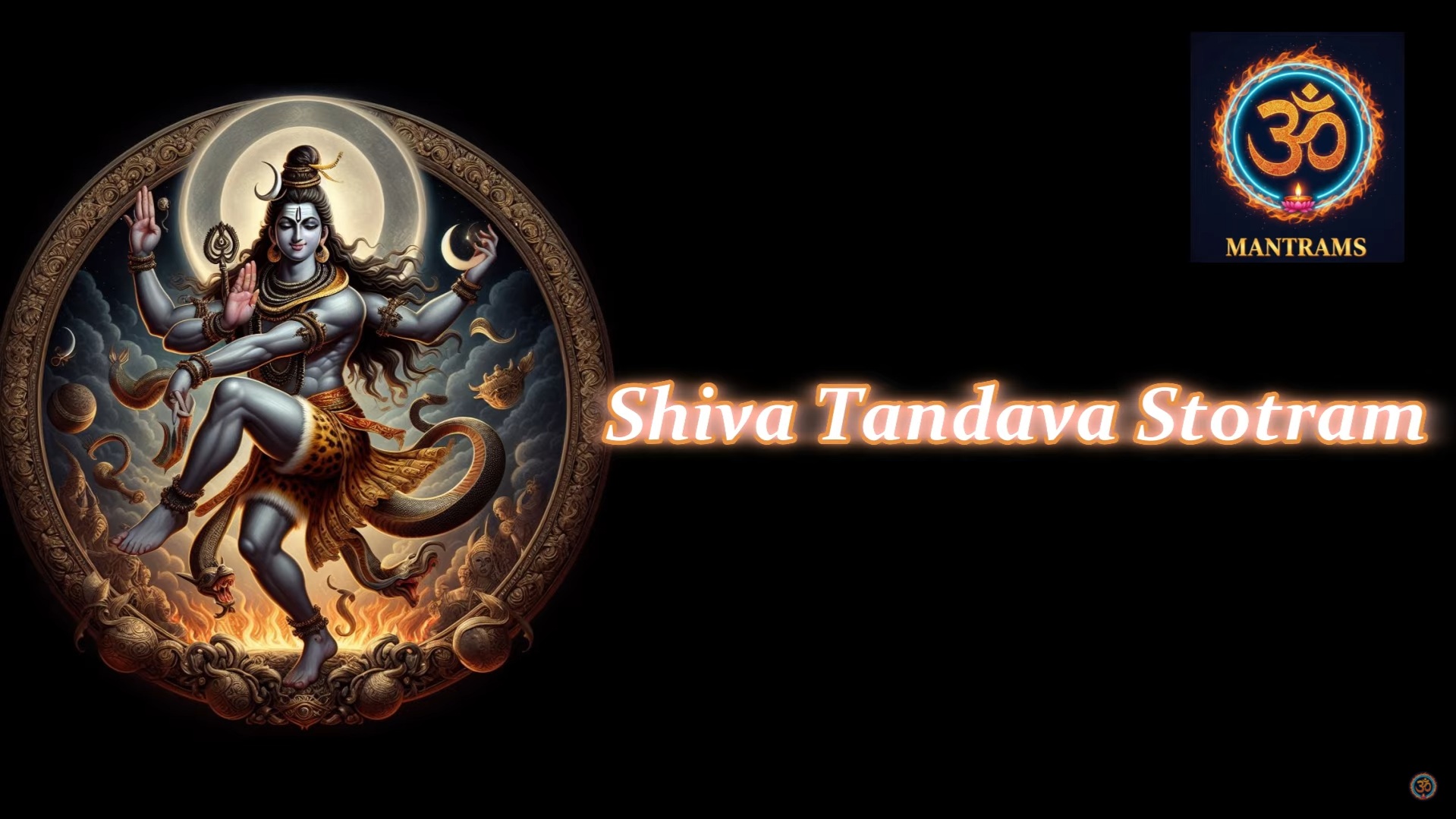
Even beyond its story, the Shiva Tāṇḍava Stotram (often simply called the Tāṇḍava Stotram) is unparalleled in its literary form. It uses a rare meter and dense alliteration, making the Sanskrit sound like a drumbeat—a verbal recreation of Shiva’s dance itself.
Take the very first verse:
jaṭā-taṭa-vī-galad-jala-pravāha-pā-vitā-sthale, gale-’va-lambya-lam-bitāṁ-bhu-jaṅ-ga-tuṅ-ga-mā-li-kām…
The repetition of sounds (especially the ‘ja-ta-ta’ and ‘la-m-ba-m’) creates a hypnotic, rhythmic flow that mirrors the ferocious energy of the Tāṇḍava—the cosmic dance of destruction. When chanted correctly, the hymn doesn’t just describe the Lord; it envelops the chanter in the chaotic yet harmonious rhythm of the universe.
The Essence of the Tāṇḍava: Destruction for Creation
The Tāṇḍava is often misunderstood as merely a dance of destruction. Philosophically, it is much more profound. It is the dance of the five cosmic actions of Shiva:
- Sṛṣṭi (Creation): The beginning of the cycle.
- Sthiti (Preservation): The maintenance of the universe.
- Saṁhāra (Destruction): The dissolution of the universe (the most visible aspect of the Tāṇḍava).
- Tirobhāva (Concealment/Illusion): The power that keeps us bound to Māyā.
- Anugraha (Grace/Salvation): The final act of liberation.
By praising the Lord in the act of his cosmic dance, the devotee is acknowledging that change is the only constant and that destruction is merely a precursor to new creation. We ask Shiva not to stop the flow of change, but to grant us the wisdom to move with it.
Unlocking the Blessings of the Hymn
The recitation of the Shiva Tāṇḍava Stotram is known to produce incredible spiritual and material benefits, particularly those associated with Shiva’s unique attributes:
– Fearlessness and Confidence: Given its origin story, the Stotram is a powerful antidote to fear. Chanting it builds immense courage and an unshakable, diamond-like confidence (Vajra-Dhāraṇa), allowing the devotee to face any adversary.
– Wealth and Prosperity: The final verses pray for wealth and auspiciousness (Lakṣmī) by asking for devotion at Shiva’s feet. Shiva is the supreme giver; once pleased, he grants all material and spiritual boons, including freedom from chronic poverty.
– Speech and Artistic Skill: Due to its complex rhythmic structure and literary beauty, regular chanting is said to grant mastery over speech and language, benefiting speakers, singers, writers, and poets.
– Karmic Purification: The hymn serves as a potent spiritual cleanser, helping to dissolve accumulated sins and negative karmic bonds, leading to inner peace and the ultimate goal of liberation (Mokṣa).
The Shiva Tāṇḍava Stotram is a raw, passionate cry of the soul to the Lord of the Cosmos. It teaches us that true strength comes not from resisting the flow of life, but from bowing down to the rhythmic, transformative power of the Divine.
Shiva Tandava Stotram Lyrics and Meaning
Jatatavigalajjala pravahapavitasthale
Galeavalambya lambitam bhujangatungamalikam
Damad damad damaddama ninadavadamarvayam
Chakara chandtandavam tanotu nah shivah shivam
With his neck consecrated by the flow of water that flows from his hair,
And on his neck a snake, which is hung like a garland,
And the Damaru drum that emits the sound “Damat Damat Damat Damat”,
Lord Shiva did the auspicious dance of Tandava. May he give prosperity to all of us.
Jata kata hasambhrama bhramanilimpanirjhari
Vilolavichivalarai virajamanamurdhani
Dhagadhagadhagajjva lalalata pattapavake
Kishora chandrashekhare ratih pratikshanam mama
I have a deep interest in Shiva
Whose head is glorified by the rows of moving waves of the celestial Ganga river,
Which stir in the deep well of his hair in tangled locks.
Who has the brilliant fire burning on the surface of his forehead,
And who has the crescent moon as a jewel on his head.
Dharadharendrana ndinivilasabandhubandhura
Sphuradigantasantati pramodamanamanase
Krupakatakshadhorani nirudhadurdharapadi
Kvachidigambare manovinodametuvastuni
May my mind seek happiness in Lord Shiva,
In whose mind all the living beings of the glorious universe exist,
Who is the companion of Parvati (daughter of the mountain king),
Who controls unsurpassed adversity with his compassionate gaze, Which is all-pervading
And who wears the Heavens as his raiment.
Jata bhujan gapingala sphuratphanamaniprabha
Kadambakunkuma dravapralipta digvadhumukhe
Madandha sindhu rasphuratvagutariyamedure
Mano vinodamadbhutam bibhartu bhutabhartari
May I find wonderful pleasure in Lord Shiva, who is the advocate of all life,
With his creeping snake with its reddish brown hood and the shine of its gem on it
Spreading variegated colors on the beautiful faces of the Goddesses of the Directions,
Which is covered by a shimmering shawl made from the skin of a huge, inebriated elephant.
Sahasra lochana prabhritya sheshalekhashekhara
Prasuna dhulidhorani vidhusaranghripithabhuh
Bhujangaraja malaya nibaddhajatajutaka
Shriyai chiraya jayatam chakora bandhushekharah
May Lord Shiva give us prosperity,
Who has the Moon as a crown,
Whose hair is bound by the red snake-garland,
Whose footrest is darkened by the flow of dust from flowers
Which fall from the heads of all the gods – Indra, Vishnu and others.
Lalata chatvarajvaladhanajnjayasphulingabha
nipitapajnchasayakam namannilimpanayakam
Sudha mayukha lekhaya virajamanashekharam
Maha kapali sampade shirojatalamastunah
May we obtain the riches of the Siddhis from the tangled strands Shiva’s hair,
Who devoured the God of Love with the sparks of the fire that burns on his forehead,
Which is revered by all the heavenly leaders,
Which is beautiful with a crescent moon.
Karala bhala pattikadhagaddhagaddhagajjvala
Ddhanajnjaya hutikruta prachandapajnchasayake
Dharadharendra nandini kuchagrachitrapatraka
Prakalpanaikashilpini trilochane ratirmama
My interest is in Lord Shiva, who has three eyes,
Who offered the powerful God of Love to fire.
The terrible surface of his forehead burns with the sound “Dhagad, Dhagad …”
He is the only artist expert in tracing decorative lines
on the tips of the breasts of Parvati, the daughter of the mountain king.
navina megha mandali niruddhadurdharasphurat
Kuhu nishithinitamah prabandhabaddhakandharah
nilimpanirjhari dharastanotu krutti sindhurah
Kalanidhanabandhurah shriyam jagaddhurandharah
May Lord Shiva give us prosperity,
The one who bears the weight of this universe,
Who is enchanting with the moon,
Who has the celestial river Ganga
Whose neck is dark as midnight on a new moon night, covered in layers of clouds.
Praphulla nila pankaja prapajnchakalimchatha
Vdambi kanthakandali raruchi prabaddhakandharam
Smarachchidam purachchhidam bhavachchidam makhachchidam
Gajachchidandhakachidam tamamtakachchidam bhaje
I pray to Lord Shiva, whose neck is bound with the brightness of the temples
hanging with the glory of fully bloomed blue lotus flowers,
Which look like the blackness of the universe.
Who is the slayer of Manmatha, who destroyed the Tripura,
Who destroyed the bonds of worldly life, who destroyed the sacrifice,
Who destroyed the demon Andhaka, who is the destroyer of the elephants,
And who has overwhelmed the God of death, Yama.
Akharvagarvasarvamangala kalakadambamajnjari
Rasapravaha madhuri vijrumbhana madhuvratam
Smarantakam purantakam bhavantakam makhantakam
Gajantakandhakantakam tamantakantakam bhaje
I pray to Lord Siva, who has bees flying all around because of the sweet
Scent of honey coming from the beautiful bouquet of auspicious Kadamba flowers,
Who is the slayer of Manmatha, who destroyed the Tripura,
Who destroyed the bonds of worldly life, who destroyed the sacrifice,
Who destroyed the demon Andhaka, who is the destroyer of the elephants,
And who has overwhelmed the God of death, Yama.
Jayatvadabhravibhrama bhramadbhujangamasafur
Dhigdhigdhi nirgamatkarala bhaal havyavat
Dhimiddhimiddhimidhva nanmrudangatungamangala
Dhvanikramapravartita prachanda tandavah shivah
Shiva, whose dance of Tandava is in tune with the series of loud
sounds of drum making the sound “Dhimid Dhimid”,
Who has fire on his great forehead, the fire that is spreading out because of the
breath of the snake, wandering in whirling motions in the glorious sky.
Drushadvichitratalpayor bhujanga mauktikasrajor
Garishtharatnaloshthayoh suhrudvipakshapakshayoh
Trushnaravindachakshushoh prajamahimahendrayoh
Sama pravartayanmanah kada sadashivam bhaje
When will I be able to worship Lord Sadashiva, the eternally auspicious God,
With equanimous vision towards people or emperors,
Towards a blade of grass and a lotus, towards friends and enemies,
Towards the most precious gem and a lump of dirt,
Toward a snake or a garland and towards the varied forms of the world?
Kada nilimpanirjhari nikujnjakotare vasanh
Vimuktadurmatih sada shirah sthamajnjalim vahanh
Vimuktalolalochano lalamabhalalagnakah
Shiveti mantramuchcharan sada sukhi bhavamyaham
When I can be happy, living in a cave near the celestial river Ganga,
Bringing my hands clasped on my head all the time,
With my impure thoughts washed away, uttering the mantra of Shiva,
Devoted to the God with a glorious forehead and with vibrant eyes?
Imam hi nityameva muktamuttamottamam stavam
Pathansmaran bruvannaro vishuddhimeti santatam
Hare gurau subhaktimashu yati nanyatha gatim
Vimohanam hi dehinam sushankarasya chintanam
Anyone who reads, remembers and recites this stotra as stated here
Is purified forever and obtains devotion in the great Guru Shiva.
For this devotion, there is no other way or refuge.
Just the mere thought of Shiva removes the delusion.