====== Similarities and Differences ======
Hinduism and Buddhism: Exploring Similarities and Differences
Introduction
Hinduism and Buddhism are two of the world’s oldest and most influential religions. Both originated in India and share many similarities, but there are also key differences that set them apart. In this article, we will explore the similarities and differences between Hinduism and Buddhism, providing a comprehensive overview of their beliefs, practices, and истории.
Similarities
1. Origin and Geography
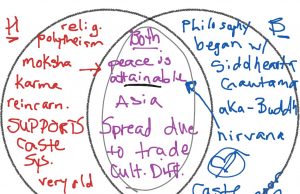
Both Hinduism and Buddhism originated in India and have a long history in the country. Hinduism is the oldest religion in the world, with its roots dating back to the Indus Valley Civilization around 5000 BCE. Buddhism was founded by Siddhartha Gautama, a prince from Lumbini, Nepal, in the 6th century BCE.
2. Belief in Karma and Reincarnation
One of the core beliefs shared by Hinduism and Buddhism is the concept of karma and reincarnation. Karma refers to the sum of one’s actions, both good and bad, which determines their future destiny. Reincarnation, or the rebirth of the soul into a new body, allows individuals to experience the consequences of their actions and progress towards spiritual liberation.
3. Emphasis on Meditation and Spiritual Practice
Both religions place great importance on meditation and spiritual practices as a means of achieving enlightenment or nirvana. In Hinduism, meditation is known as yoga and aims to unite the individual with the divine. In Buddhism, meditation is a central component of the Eightfold Path, which leads to the end of suffering and the attainment of enlightenment.
4. Use of Symbols and Iconography
Hinduism and Buddhism both use symbols and iconography to represent their beliefs and practices. In Hinduism, the sacred symbol of “Om” represents the divine, while in Buddhism, the lotus flower symbolizes purity and spiritual awakening.
Differences
1. God and Divinity
Hinduism is a polytheistic religion, with a vast pantheon of gods and goddesses. Each deity represents different aspects of the divine, and devotees may choose to worship specific gods or goddesses based on their personal preferences. In contrast, Buddhism is a non-theistic religion that does not believe in a personal creator god. Instead, it emphasizes the importance of following the teachings of the Buddha and striving for enlightenment.
2. Social Hierarchy and Caste System
Hinduism has a complex social hierarchy based on the caste system, which divides society into different classes. The caste system determines an individual’s social status, occupation, and privileges. Buddhism, on the other hand, rejects the caste system and teaches that all beings are equal.
3. Role of the Priesthood
In Hinduism, priests play a significant role in religious ceremonies and rituals. They are responsible for conducting rituals, interpreting scriptures, and guiding devotees in their spiritual practices. In Buddhism, there is no formal priesthood. Instead, monks and nuns serve as teachers and guides, but they do not have the same authority or power as priests in Hinduism.
4. Ultimate Goal
The ultimate goal of Hinduism is to achieve moksha, or liberation from the cycle of birth and death. This is achieved through spiritual practices, devotion to the gods, and the accumulation of good karma. In Buddhism, the ultimate goal is to attain nirvana, the state of perfect peace and freedom from suffering.
Conclusion
Hinduism and Buddhism are two distinct religions with their own unique beliefs, practices, and histories. While they share some similarities, such as their origin in India, belief in karma and reincarnation, and emphasis on spiritual practices, there are also key differences that set them apart. Understanding these similarities and differences can help us appreciate the diversity of religious traditions and their contributions to human civilization.
Secondary Keywords
Comparative Religion, Hinduism, Buddhism, Karma, Reincarnation, Meditation, Nirvana, God, Caste System, Priesthood, Moksha