====== Time ======
Time: The Illusion of Linearity
Time is one of the most fundamental concepts in the human experience. We are constantly aware of its passage, as it shapes our lives from the moment we are born until the moment we die. But what exactly is time? Is it a constant, objective force that flows in one direction, or is it a subjective experience that varies from person to person?
In this article, we will explore the Hindu concept of time, which offers a unique and insightful perspective on this enigmatic phenomenon. According to the Hindu tradition, time is not a linear progression, but rather a cyclical process that consists of four distinct ages, or yugas.
The Four Yugas
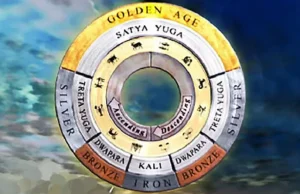
The four yugas are:
- Satya Yuga (Golden Age): A time of truth, purity, and harmony. People live in peace and abundance, and there is no suffering or disease.
- Treta Yuga (Silver Age): A time of slightly diminished virtue. People are still generally good, but there is some selfishness and greed.
- Dwapara Yuga (Bronze Age): A time of further decline in virtue. People are more selfish and greedy, and there is more conflict and suffering.
- Kali Yuga (Iron Age): The current age, a time of great darkness and ignorance. People are selfish, greedy, and violent, and the world is full of suffering.
Each yuga lasts for a specific period of time, and the cycle repeats itself over and over again. The current Kali Yuga began in 3102 BCE and is said to last for 432,000 years.
The Nature of Time
The Hindu concept of time is based on the idea that time is not a separate entity, but rather an aspect of consciousness. Time is not something that exists outside of us; it is something that we create and experience within ourselves.
This concept of time is very different from the Western view of time as a linear progression. In the Western view, time is seen as a constant, objective force that flows in one direction. We cannot control time or change its flow; we can only move forward with it.
The Hindu view of time, on the other hand, is more subjective and flexible. Time is not seen as a constant force that we are subject to; it is something that we can shape and experience in different ways.
The Importance of Time
Time is an essential part of the human experience. It shapes our lives in many ways, from the mundane to the profound. It is important to understand the nature of time so that we can make the most of it.
In the Bhagavad Gita, Krishna says, “Time is the destroyer of all things.” This is a reminder that time is a powerful force that can change everything. We cannot control time, but we can control how we use it.
We should use our time wisely, doing things that are meaningful and fulfilling. We should not waste our time on things that are unimportant or that will not bring us happiness.
Conclusion
Time is a mysterious and fascinating phenomenon. The Hindu concept of time offers a unique and insightful perspective on this enigma. By understanding the Hindu view of time, we can gain a deeper appreciation for the nature of time and its importance in our lives.
Secondary Keywords:
- Hindu time
- Cycles of time
- Ages of time
- Satya Yuga
- Kali Yuga