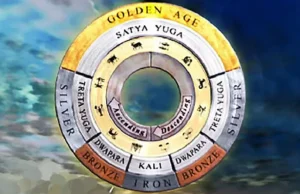
====== Yuga ======
The Hindu Concept of Time: Understanding Cycles and Ages
Introduction
Time is a fascinating concept that has puzzled philosophers, scientists, and theologians for centuries. Different cultures have developed their own unique ways of understanding and measuring time. One of the most intriguing concepts of time comes from the ancient Hindu tradition, which posits the existence of yugas, or cosmic cycles.
What is a Yuga?
A yuga is a vast period of time that is believed to be a cycle of creation, preservation, and destruction. Each yuga is characterized by its own distinct qualities and characteristics.
The Four Yugas
The Hindu tradition recognizes four primary yugas:
1. Satya Yuga (Golden Age)
- Duration: 1,728,000 years
- Characteristics: Purity, righteousness, truth, and harmony
- People: Highly virtuous and spiritual
2. Treta Yuga (Silver Age)
- Duration: 1,296,000 years
- Characteristics: Some decline in righteousness and spiritual practices
- People: Less virtuous but still inclined towards goodness
3. Dvapara Yuga (Copper Age)
- Duration: 864,000 years
- Characteristics: Further decline in righteousness, rise of materialism
- People: Moderately virtuous but prone to conflicts and desires
4. Kali Yuga (Iron Age)
- Duration: 432,000 years
- Characteristics: Dominated by vice, ignorance, and chaos
- People: Highly materialistic, selfish, and prone to violence
The Cycle of Yugas
The four yugas are believed to repeat themselves in a cyclical pattern, with each yuga transitioning into the next. The cycle is believed to be eternal, with no beginning or end.
The Current Yuga
According to Hindu tradition, we are currently in the Kali Yuga, which began approximately 5,000 years ago. This yuga is characterized by materialism, violence, and a decline in spiritual values.
The End of a Yuga
Each yuga is believed to end in a cataclysmic event known as pralaya. During pralaya, the universe is dissolved and reabsorbed into the creator god, Brahma.
Significance of the Yuga Concept
The concept of yugas provides a framework for understanding the cyclical nature of existence. It teaches that periods of prosperity and decline are inherent in the unfolding of time. By understanding the current yuga, we can gain insights into the challenges and opportunities that lie ahead.
Conclusion
The Hindu concept of yugas is a profound and insightful way of understanding the nature of time. It offers a cyclical perspective that emphasizes the interconnectedness of all things and the inevitability of change. By embracing this concept, we can develop a deeper understanding of our place in the universe and the journey of human evolution.
Secondary Keywords:
- Hindu cosmology
- Cosmic cycles
- Time perception
- Satya Yuga
- Kali Yuga