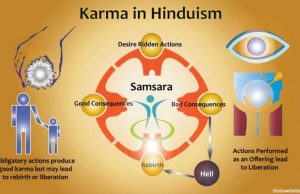
The Evolution of Karma in Hinduism Over Time
Vedic Period (c. 1500-500 BCE)
- Karma was primarily associated with rituals and sacrifices.
- Actions performed in accordance with Vedic injunctions accrued merit (punya), while wrong actions incurred sin (papa).
- The consequences of karma were experienced primarily in the present life, although some believed in rebirth.
Upanishadic Period (c. 800-500 BCE)
- The concept of rebirth became more prominent.
- Karma was seen as a moral law that determined one’s destiny in subsequent lives.
- The consequences of karma could extend beyond one’s own life and impact future generations.
Classical Hinduism (c. 500 BCE-500 CE)
- The Bhagavad Gita emphasized the importance of selfless action (nishkama karma).
- Actions performed without desire for reward or fear of punishment did not accrue karma.
- The ultimate goal was to achieve liberation (moksha) from the cycle of rebirth.
Medieval Period (c. 500-1500 CE)
- The concept of subtle karma emerged, referring to the karmic consequences of thoughts, intentions, and emotions.
- Karma was seen as operating on multiple levels: individual, communal, and cosmic.
- Karma could be modified through rituals, penance, and asceticism.
Modern Hinduism (c. 1500-Present)
- The concept of karma has become more universalized and accessible to all devotees.
- The focus has shifted from deterministic karma to the power of personal actions and choices.
- Karma is seen as a tool for spiritual growth and transformation.
Key Changes in the Evolution of Karma
- Expansion of the Scope of Karma: From rituals to thoughts and intentions.
- Emphasis on Moral Dimension: Karma became a moral law that determined one’s destiny.
- Introduction of Rebirth: Karma was connected to the cycle of rebirth, extending its consequences beyond one’s lifetime.
- Importance of Selfless Action: Righteous actions should be performed without desire for reward or fear of punishment.
- Concept of Subtle Karma: Karma could be non-physical and affect one’s inner self.
- Modifiability of Karma: Karma could be mitigated through rituals and personal efforts.
- Universalization of Karma: The concept became applicable to all devotees, regardless of their caste or social status.
- Focus on Spiritual Growth: Karma is now seen as a path to personal and spiritual transformation.## The Evolution Of Karma In Hinduism Over Time
Executive Summary
Karma, a central concept in Hinduism, has undergone significant evolution over time. This article explores the multifaceted nature of karma, tracing its origins in the Vedas to its later interpretations in the Upanishads and Puranas. By examining the historical development of karma, we gain a deeper understanding of its profound impact on Hindu thought and practice.
Introduction
Karma, a Sanskrit word meaning “action,” holds a pivotal position within the Hindu belief system. It encompasses the notion that every action, thought, or word has consequences, both in this life and beyond. The concept of karma has evolved over centuries, shaping the ethical and spiritual framework of Hinduism.
FAQ
- What is the meaning of karma in Hinduism? Karma refers to the law of cause and effect, where actions, both good and bad, have corresponding consequences.
- How does karma determine one’s destiny? According to Hindu belief, the accumulation of past karma influences an individual’s current life experiences, including their social status, wealth, and health.
- Can karma be changed? While it is believed that karma is a powerful force, certain practices such as performing good deeds, seeking forgiveness, and practicing meditation can mitigate its negative consequences.
Subtopics
Vedic Origins of Karma
- Belief in afterlife: The Vedas, the oldest Hindu scriptures, mention the concept of heaven and hell, suggesting that actions in this life have implications in the next.
- Perfection of actions: The Vedas emphasize the importance of performing actions without attachment to the outcome, focusing on the selfless fulfillment of duty.
- Sacrificial rituals: Rituals and sacrifices played a significant role in karma, as they were believed to bring blessings and prosperity.
- Ethics and morality: The Vedas outline moral guidelines, such as the avoidance of violence, theft, and falsehood, which influence the accumulation of karma.
- Individual responsibility: The Vedas stress the personal responsibility for one’s actions and their consequences.
Upanishadic Interpretation of Karma
- Emphasis on inner intent: The Upanishads shifted the focus from external actions to inner intentions, arguing that thoughts and desires also have karmic consequences.
- The law of rebirth: The Upanishads introduced the concept of rebirth, where individuals are born into different circumstances based on their past karma.
- Karmic cycle: The Upanishads describe karma as a never-ending cycle, where actions in one life influence the next.
- Moksha as the goal: The ultimate goal of karma is to break the cycle of rebirth and achieve moksha, a state of liberation from the limitations of existence.
- Renunciation and asceticism: Many Upanishadic sages advocated for renunciation and asceticism as paths to transcend the effects of karma.
Puranic Elaboration of Karma
- Cosmic forces: The Puranas introduced the concept of cosmic forces, known as the gods and goddesses, who oversee the administration of karma.
- Divine retribution: The Puranas emphasize the idea of divine retribution, where individuals are held accountable for their actions before a divine judge.
- Balancing of karma: The Puranas describe the existence of multiple realms where individuals experience the consequences of their karma, balancing out both good and bad deeds.
- Influence of social status: The Puranas suggest that social status and wealth can be influenced by past karma.
- Expiation of sins: The Puranas provide rituals and practices for expiating sins and mitigating the negative effects of karma.
Conclusion
The evolution of karma in Hinduism over time has been a continuous process of refinement and expansion. From its Vedic origins to its later interpretations in the Upanishads and Puranas, the concept of karma has provided a framework for understanding individual responsibility, ethical conduct, and the nature of existence. By tracing the historical development of karma, we gain a deeper appreciation for its profound influence on Hindu thought and practice, guiding individuals towards spiritual growth and ultimate liberation.
Keywords
- Karma
- Hinduism
- Vedic origins
- Upanishadic interpretation
- Puranic elaboration