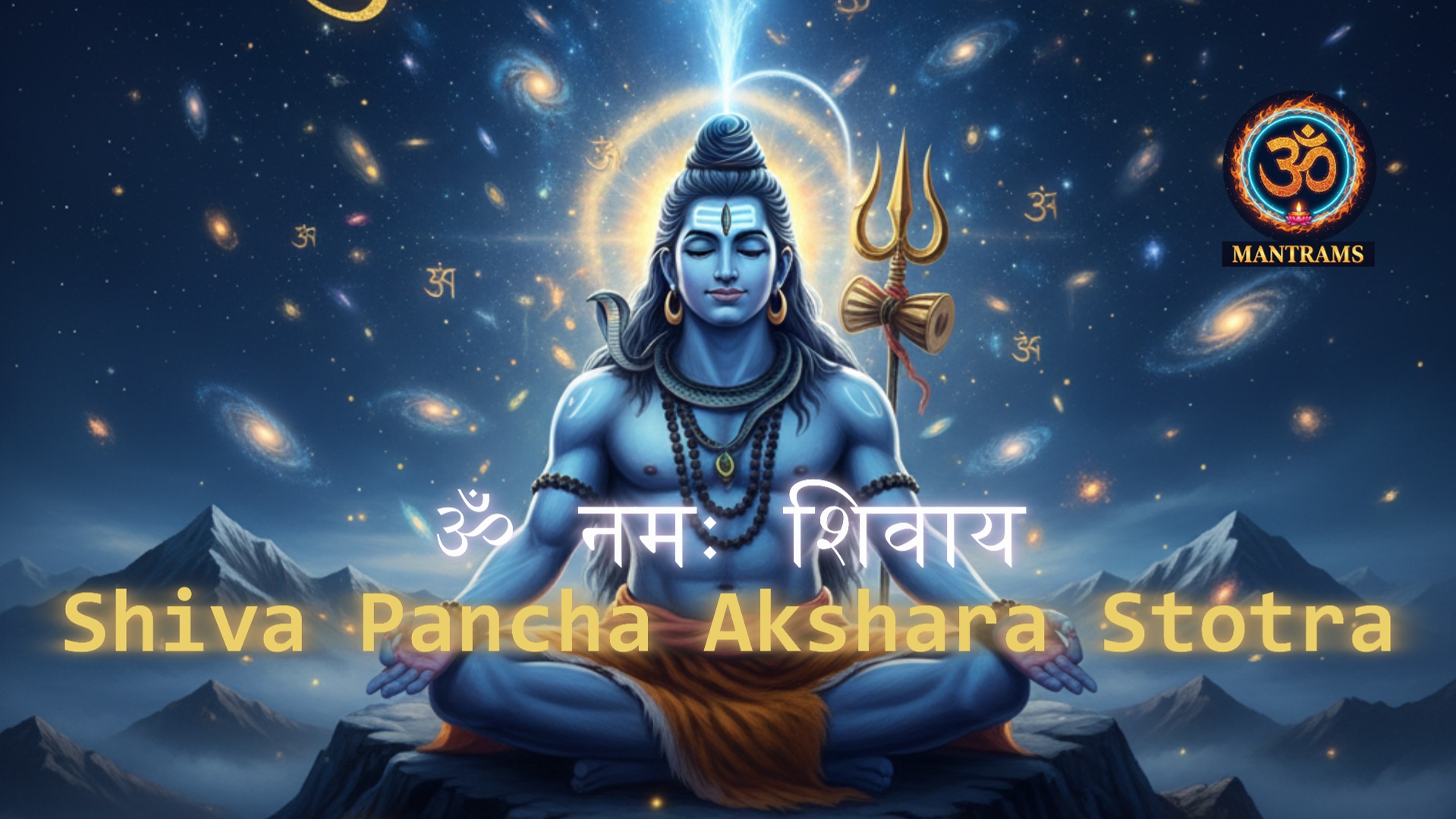
The Simplicity of the Eternal Truth
There are some spiritual formulas that contain the entire universe within their sound. For devotees of Lord Shiva, this truth is contained in five simple syllables: Na-Ma-Śi-Vā-Ya. This is the Pancha Akshara Mantra, the “Five-Syllable Mantra,” considered the heart of the Vedas and the supreme mantra of liberation.
But the sheer simplicity of the mantra sometimes hides its profound depth. To unlock the full glory of these syllables, the great sage and philosopher Adi Shankaracharya composed the exquisite Shiva Pancha Akshara Stotra (Hymn of the Five Syllables). This short, six-verse hymn is a spiritual masterpiece that doesn’t just praise Shiva; it details how each syllable relates to His divine form, His cosmic activities, and even the five fundamental elements of existence.
Reciting this stotra isn’t just chanting; it’s a meditative act that systematically aligns your consciousness with the highest form of reality, promising nothing less than the attainment of Śiva-Loka (the abode of Shiva) and eternal bliss.
A Syllable-by-Syllable Meditation: The Elemental Connection
The brilliance of this stotra is that it dedicates one entire verse to each of the five syllables, revealing a hidden map for the spiritual journey. Traditional Shaiva wisdom links these syllables to the five great elements (Pañcha Bhūtas), the foundational building blocks of the human body and the cosmos:
1. Na: The Earth Element (Pṛthvī)
The stotra begins with ‘Na’ (ना), dedicating it to Lord Shiva as:
The one wearing a garland of the chief of serpents, with three eyes; whose body is smeared with sacred ashes, the Great Lord. To the Eternal, the ever-pure, the one clothed by the directions.
‘Na’ represents the Earth element. It is the solid ground of your existence, symbolizing the ego (Anava Mala*).* By bowing to ‘Na,’ we recognize that everything that seems solid—our possessions, our body, our sense of self—is Shiva. The mantra asks us to dissolve the heavy, limiting nature of the ego, offering it back to the Lord who wears the universe as his robe.
2. Ma: The Water Element (Jala)
The next syllable, ‘Ma’ (म), is an invocation to Shiva as:
He who is worshipped with the waters of the Mandākinī river and anointed with sandal paste; the Lord of Nandi and the chief of the celestial attendants (Pramatha).
‘Ma’ represents the Water element, symbolizing the flow of Karma in our life. Water is used for purification and worship. By chanting ‘Ma,’ we ask Shiva to cleanse us of the accumulated actions and desires that bind us. It is a prayer for purification, allowing the consciousness to flow freely, unburdened by past deeds.
3. Śi: The Fire Element (Agni)
The central, most auspicious syllable is ‘Śi’ (शि), addressed to Shiva as:
The auspicious one, who is like the sun causing the lotus face of Gaurī (Pārvatī) to blossom; the destroyer of Dakṣa’s sacrifice; the Blue-Throated one.
‘Śi’ embodies the Fire element, the power of Transformation that burns away ignorance. Shiva, the auspicious one (Śiva literally means auspiciousness), destroyed Dakṣa’s ego-driven ritual with his fierce power. This syllable is the transformative energy that brings auspiciousness, illuminating the darkness of the mind like the rising sun.
4. Vā: The Air Element (Vāyu)
The fourth syllable, ‘Vā’ (वा), is dedicated to Shiva as:
He who is worshipped by the greatest sages like Vasiṣṭha, Agastya, and Gautam; whose eyes are the moon, sun, and fire; the crown jewel of the universe.
‘Vā’ represents the Air element, symbolizing the omnipresent nature of the Lord. Just as air is everywhere, Shiva is the essence of all beings, worshipped by all authorities—sages, gods, and enlightened beings. This syllable calls on the light of wisdom, illuminating the path and providing the omnipresent guidance that surrounds all sincere seekers.
5. Ya: The Space/Ether Element (Ākāśa)
Finally, ‘Ya’ (य) concludes the prayer by addressing Shiva as:
The embodiment of Yagna (sacrifice); who holds the trident (Pināka) and has matted locks; the Divine, the Shining One, the Eternal.
‘Ya’ is the Space or Ether element, representing the immortal Soul (Ātman). Space is that which contains everything but is contained by nothing. This syllable affirms that Shiva is the inner essence, the Ātman, which is eternal, divine, and free from all limitations. It is the final realization: the self is Shiva.
The Ultimate Promise: Bliss and Liberation
The conclusion of the Shiva Pancha Akshara Stotra states simply: “Whoever recites this virtuous Panchakshara Stotra near Shiva will attain the abode of Shiva and rejoice with Him.”
This is the ultimate, non-negotiable benefit. The stotra is a simple, beautiful mechanism for meditation and devotion, built on the most powerful mantra in the Shaiva tradition. By understanding and reciting it, you align the five elements of your body with the five universal principles, effortlessly guiding your soul toward its eternal source of bliss.
Have you had a personal experience with the Pancha Akshara mantra, or would you like to explore another one of Shankaracharya’s famous stotras?
Shiva Pancha Akshara Stotra Mantra
Shiva-Pancha-Akshara-Stotra
Text 1
नागेन्द्रहाराय त्रिलोचनाय
भस्माङ्गरागाय महेश्वराय ।
नित्याय शुद्धाय दिगम्बराय
तस्मै ‘न’-काराय नमः शिवाय ॥ १॥
nāgendrahārāya trilocanāya
bhasmāṅgarāgāya maheśvarāya |
nityāya śuddhāya digambarāya
tasmai Na-kārāya namaḥ śivāya || 1||
Salutations to Shiva, who wears the King of snakes as a garland, the Three-eyed God, whose body is smeared with ashes, the great Lord, the eternal and pure One, who wears the directions as His garment, and who is represented by the first letter ’na’. (1)
Text 2
मन्दाकिनीसलिलचन्दनचर्चिताय
नन्दीश्वरप्रमथनाथमहेश्वराय ।
मन्दारपुष्पबहुपुष्पसुपूजिताय
तस्मै ‘म’-काराय नमः शिवाय ॥ २॥
mandākini-salilacandana-carcitāya
nandīśvara-pramathanātha- maheśvarāya |
mandārapuṣpa-bahupuṣpa-supūjitāya
tasmai Ma-kārāya namaḥ śivāya || 2||
I bow to Shiva, who has been worshipped with water from the Ganga (Mandakini-River) and anointed with sandalwood paste, the Lord of nandi, the Lord of the host of goblins and ghosts, the great Lord, who is worshiped with mandara and many other kinds of flowers, and who is represented by the syllable ‘ma’. (2)
Text 3
शिवाय गौरीवदनाब्जवृन्द-
सूर्याय दक्षाध्वरनाशकाय ।
श्रीनीलकण्ठाय वृषध्वजाय
तस्मै ‘शि’-काराय नमः शिवाय ॥ ३॥
śivāya gaurīvadanābja-vṛnda-
sūryāya dakṣādhvaranāśakāya |
śrīnīlakaṇṭhāya vṛṣadhvajāya
tasmai śi-kārāya namaḥ śivāya || 3||
Salutations to Shiva, who is all-auspiciousness, Who is the sun that causes the lotus face of Gauri (ParvatI) to blossom, Who is the destroyer of the Yajna of daksha, whose throat is blue (Nilakantha), whose flag bears the emblem of the bull, and who is represented by the syllable ‘si’. (3)
Text 4
वसिष्ठकुम्भोद्भवगौतमार्य-
मुनीन्द्रदेवार्चितशेखराय
चन्द्रार्कवैश्वानरलोचनाय
तस्मै ‘व’-काराय नमः शिवाय ॥ ४॥
vasiṣṭha-kumbhodbhava-gautamārya
munīndra-devārcitaśekharāya |
candrārka-vaiśvānaralocanāya
tasmai Va-kārāya namaḥ śivāya || 4||
Vasishhtha, Agastya, Gautama, and other venerable sages, and Indra and other Gods have worshipped the head of (Shiva’s linga). I bow to that Shiva whose three eyes are the moon, sun and fire, and who is represented by the syllable ‘va’. (4)
Text 5
यक्षस्वरूपाय जटाधराय
पिनाकहस्ताय सनातनाय
दिव्याय देवाय दिगम्बराय
तस्मै ‘य’-काराय नमः शिवाय ॥ ५॥
yakṣasvarūpāya jaṭādharāya
pinākahastāya sanātanāya |
divyāya devāya digambarāya
tasmai Ya-kārāya namaḥ śivāya || 5||
Salutations to Shiva, who bears the form of a Yaksha, who has matted hair on His head, Who bears the Pinaka bow in His hand, the Primeval Lord, the brilliant God, who is Digambara (naked), and who is represented by the syllable ‘ya’. (5)
पञ्चाक्षरमिदं पुण्यं यः पठेच्छिवसन्निधौ ।
शिवलोकमवाप्नोति शिवेन सह मोदते ॥
pañcākṣaramidaṁ puṇyaṁ yaḥ paṭhecchivasannidhau |
śivalokamavāpnoti śivena saha modate ||
Anyone who recites this sacred five-syllabled mantra,
(namah shivaya) – [om namo shivaya]
attains the abode of Shiva and rejoices there with Shiva.
|| iti śrī śiva pañcākśara stotraṁ sampūrṇaṁ ||
– thus ends the hymn ‘śiva pañcākśara stotraṁ’ –