The Hindu Concept of Yugas: Cycles of Time and Evolution
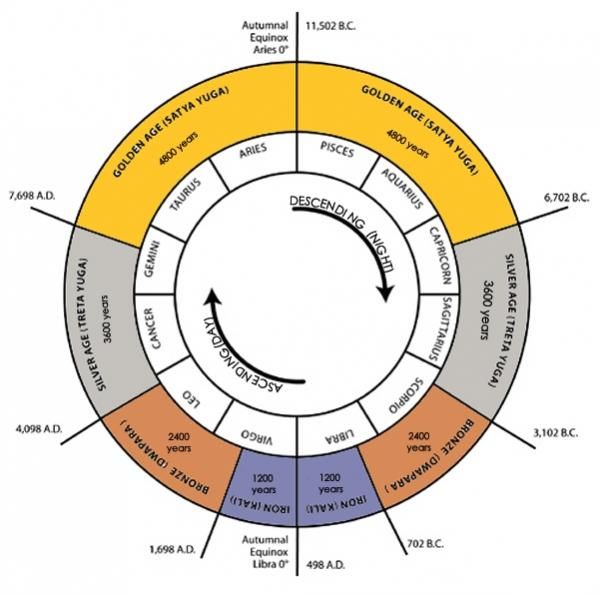
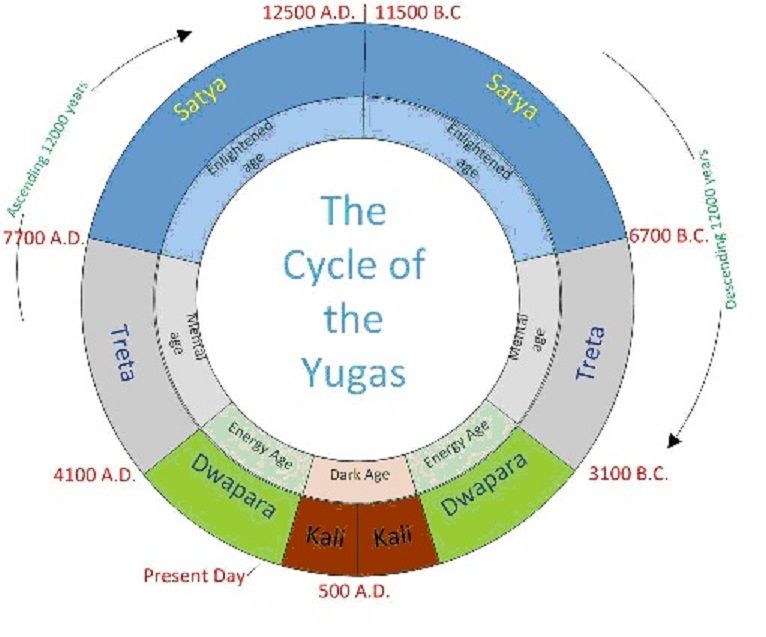
According to Hindu cosmology, time is cyclical and consists of four distinct yugas, or ages:
1. Satya Yuga (Golden Age):
- Characterized by truth, harmony, and righteousness
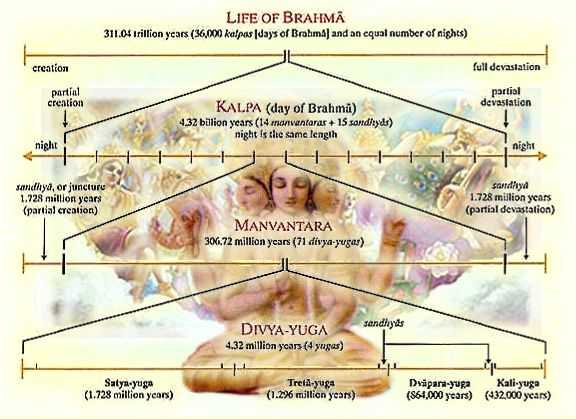
- Duration: 1,728,000 years
- Human life is long, healthy, and free from suffering
- Knowledge and wisdom prevail
2. Treta Yuga (Silver Age):
- A period of decline from Satya Yuga
- Duration: 1,296,000 years
- Religious practices and rituals become more important
- There is a slight increase in suffering and injustice
3. Dwapara Yuga (Copper Age):
- Further decline from Treta Yuga
- Duration: 864,000 years
- Materialism and selfishness become more pronounced
- The use of deception and violence increases
4. Kali Yuga (Iron Age):
- The current age, characterized by strife, ignorance, and spiritual darkness
- Duration: 432,000 years
- Human life is short, full of suffering, and dominated by materialism
- The decline of religion and morality reaches its peak
Evolution of Consciousness:
The yuga cycle is also seen as a process of spiritual evolution. Each yuga represents a different level of consciousness:
- Satya Yuga: Highest level of consciousness, characterized by purity and enlightenment
- Treta Yuga: Moderate level of consciousness, where spirituality is still strong
- Dwapara Yuga: Lower level of consciousness, where material pursuits gain importance
- Kali Yuga: Lowest level of consciousness, marked by ignorance and spiritual darkness
Cyclic Nature:
The yuga cycle is perpetual, with the end of Kali Yuga leading back to the beginning of Satya Yuga. This continuous cycle reflects the nature of existence, where everything is subject to change and renewal.
Current Era:
Hindus believe that the current era is Kali Yuga, which began in 3102 BCE. This is a time of great challenges but also of spiritual opportunity. The goal is to transcend the limitations of Kali Yuga and strive for higher levels of consciousness.
The Hindu concept of yugas provides a framework for understanding the cycles of time and the evolution of consciousness. It encourages individuals to recognize the transient nature of existence and to seek spiritual liberation amidst the challenges of the present age.## The Hindu Concept of Yugas: Cycles of Time and Evolution
Executive Summary
The Hindu concept of yugas presents a cyclical view of time, where the universe goes through repetitive cycles of creation, dissolution, and renewal. These yugas represent distinct epochs characterized by specific qualities and events, shaping the evolution and consciousness of beings.
Introduction
In the vast tapestry of Hindu thought, the concept of yugas stands as a profound and multifaceted cosmology. It paints a picture of time as a cyclical dance, where epochs of creation, preservation, destruction, and renewal unfold in a ceaseless rhythm. This article delves into the intricacies of yugas, exploring their significance and the profound implications they hold for human existence.
FAQs
Q: What exactly is a yuga?
A: Yugas are cosmic time cycles that constitute the framework of Hindu cosmology. Each yuga is associated with specific attributes and qualities, influencing the nature of reality and shaping the evolution of beings.
Q: How many yugas are there in a complete cycle?
A: There are four primary yugas in a complete cycle: Satya Yuga, Treta Yuga, Dwapara Yuga, and Kali Yuga. Each yuga represents a decline in spiritual purity and a corresponding increase in material influence.
Q: What is the significance of yugas in human evolution?
A: Yugas provide a framework for understanding the ebb and flow of human consciousness. They suggest that individuals and societies experience periods of great spiritual progress followed by decline, mirroring the cosmic cycles.
Subtopics
Satya Yuga
- Duration: 1,728,000 years
- Characteristics: Also known as the Golden Age, Satya Yuga is marked by harmony, purity, and spiritual awakening.
- Moral standards: High adherence to dharma, truthfulness, and compassion.
- Dominant Gunas: Sattwa (balance, purity)
Treta Yuga
- Duration: 1,296,000 years
- Characteristics: Known as the Silver Age, Treta Yuga witnesses a slight decline in spiritual purity and an increase in material attachments.
- Moral standards: Dharma is still strong, but self-interest begins to emerge.
- Dominant Gunas: Sattwa and Rajas (passion, activity)
Dwapara Yuga
- Duration: 864,000 years
- Characteristics: Also known as the Bronze Age, Dwapara Yuga experiences a further decline in spiritual purity along with a rise in ego and competition.
- Moral standards: Dharma is challenged, and greed and exploitation increase.
- Dominant Gunas: Rajas and Tamas (inertia, darkness)
Kali Yuga
- Duration: 432,000 years
- Characteristics: Known as the Iron Age, Kali Yuga is marked by extreme spiritual decline, rampant materialism, and social degradation.
- Moral standards: Dharma is weakened, and violence, dishonesty, and corruption prevail.
- Dominant Gunas: Tamas and Rajas
Cosmic Dissolution
- Duration: Unknown
- Characteristics: The end of a complete yuga cycle results in the dissolution of the universe into a primordial state of chaos known as Pralaya.
Conclusion
The Hindu concept of yugas encapsulates a deep understanding of time, evolution, and the nature of reality. It provides a framework for comprehending the cyclical nature of human existence, highlighting the ebb and flow of spiritual progress and decline. By embracing the wisdom of yugas, individuals can navigate the challenges and optimize the opportunities presented in each cosmic epoch, striving to achieve spiritual liberation amidst the cosmic cycles.
Keyword Tags
- Hindu cosmology
- Yugas
- Time cycles
- Evolution
- Spiritual progress