Maya in Advaita Vedanta: Unveiling the Illusion of the Phenomenal World
Introduction
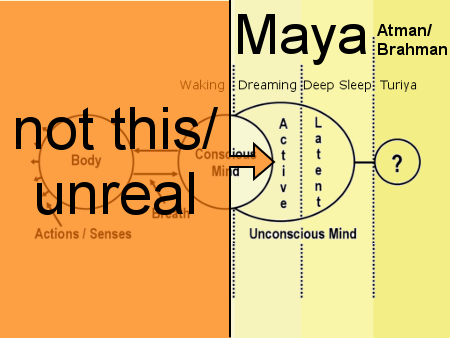
Advaita Vedanta, a non-dualistic philosophy, posits that the ultimate reality, Brahman, is one without a second. It asserts that the phenomenal world, Jagat, is an illusion, a superimposition on Brahman, caused by Maya. Maya is a fundamental concept in Advaita Vedanta, referring to the power that obscures the true nature of Brahman and projects the illusory world.
Understanding Maya
Maya is not an absolute negation but rather a transformative power. It is not a separate entity but an inherent quality of the mind. Maya operates in two distinct ways:
- Avarana Shakti (Veiling Power): This aspect of Maya conceals the true nature of Brahman, making it appear as the phenomenal world. It projects a veil of ignorance over the mind, preventing the realization of the absolute.
- Vikshepa Shakti (Projecting Power): This aspect of Maya projects the illusory world onto the consciousness. It creates the appearance of diversity and multiplicity out of the underlying unity of Brahman.
The Phenomenal World as Maya
Advaita Vedanta asserts that the phenomenal world, Jagat, is a product of Maya. It is not a creation but an illusion, a misperception of reality. The world appears real due to the superimposition of concepts, names, and forms onto Brahman. This superimposition is called Adhyasa.
For example, when we perceive a rope as a snake, the illusion is created by the superimposition of the concept “snake” onto the rope. Similarly, Maya projects the illusion of the world onto the underlying Brahman.
Overcoming Maya
Maya is a powerful force, but it can be overcome through the process of self-realization or Jnana Yoga. This involves:
- Self-inquiry (Atma Vichara): Examining the nature of the Self to distinguish it from the illusory world.
- Discrimination (Viveka): Differentiating between the real and the unreal, between Brahman and Maya.
- Meditation (Dhyana): Focusing the mind on Brahman to weaken the hold of Maya.
Conclusion
Maya is a fundamental concept in Advaita Vedanta. It refers to the power that obscures the true nature of Brahman and projects the illusion of the phenomenal world. The world we experience is not real but an illusion created by the superimposition of concepts and forms onto Brahman. Overcoming Maya requires self-inquiry, discrimination, and meditation, leading to the realization of the absolute unity of Brahman.# Maya In Advaita Vedanta: Unveiling The Illusion Of The Phenomenal World
Executive Summary
Advaita Vedanta, a non-dualistic school of Hindu philosophy, posits that the phenomenal world, characterized by duality and multiplicity, is an illusion (maya) that obscures the underlying unity of reality. This article delves into the concept of maya in Advaita Vedanta, exploring its nature, its impact on perception, and the path to transcending it.
Introduction
The world we perceive, with its myriad forms, objects, and experiences, is often taken as an objective reality. However, Advaita Vedanta challenges this assumption, asserting that the phenomenal world is a mere illusion, a veil that conceals the true nature of reality. This illusion is known as maya.
FAQs
- What is maya?
Maya is the power of illusion that projects the phenomenal world onto the fabric of consciousness. It is the source of duality and multiplicity, veiling the underlying unity of reality. - How does maya impact perception?
Maya distorts our perceptions, causing us to see the world as separate and fragmented. It creates the illusion of time and space, obscuring the timeless and infinite nature of reality. - Can we transcend maya?
While maya is a powerful illusion, Advaita Vedanta teaches that it can be transcended through spiritual practices, such as meditation, self-inquiry, and selfless action.
Subtopics
The Nature of Maya
- Maya is not a material substance or an objective entity.
- It is a subjective illusion, a projection of consciousness.
- Maya is the power that transforms the formless into form, the infinite into the finite.
Maya and Creation
- Maya is the power that manifest the phenomenal world.
- It projects the universe from the unmanifest state into the manifest state.
- The phenomenal world is a reflection of our collective consciousness, shaped by our desires, beliefs, and limitations.
Maya and Suffering
- Maya is the root cause of suffering.
- Attachment to the illusory world leads to dissatisfaction, longing, and disappointment.
- To transcend suffering, one must recognize the illusory nature of the phenomenal world.
Maya and Liberation
- Transcending maya is the goal of spiritual practice.
- Liberation is achieved when one realizes the unity of all things and the illusory nature of the phenomenal world.
- True freedom lies in shedding the veil of maya and embracing the timeless, infinite Self.
Maya and Enlightenment
- Enlightenment is the state of complete awareness in which maya is fully dispelled.
- An enlightened being perceives the world as a manifestation of their own consciousness.
- They understand the illusory nature of duality and experience the unity of all things.
Conclusion
Maya, the illusion of the phenomenal world, is a central concept in Advaita Vedanta. Recognizing its illusory nature is a crucial step on the path to self-realization. Through spiritual practices, we can pierce the veil of maya and experience the boundless, unified reality that lies beneath.
Keyword Tags
- Advaita Vedanta
- Maya
- Illusion
- Phenomenal world
- Enlightenment